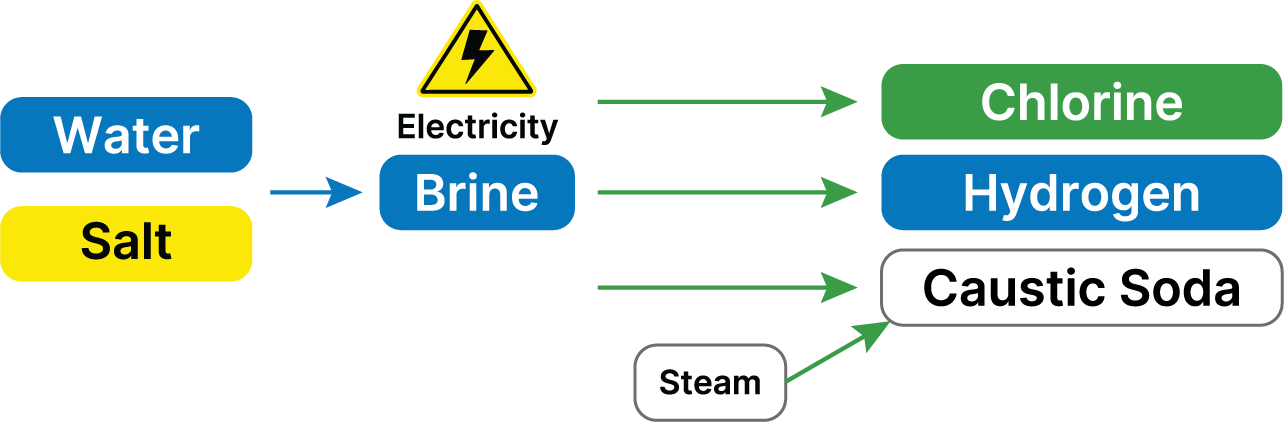
The mercury cell process
In the mercury cell process, sodium forms an
amalgam (a 'mixture' of two metals) with the mercury at the
cathode. The amalgam reacts with the water in a separate reactor
called a decomposer where hydrogen gas and caustic soda solution at
50% are produced.
As the brine is usually re-circulated, solid salt is required to
maintain the saturation of the salt water. The brine is first
de-chlorinated and then purified by a precipitation-filtration
process. The products are extremely pure. The chlorine, along with
a little oxygen, generally can be used without further
purification.
View the animated mercury cell
process.
Of the three processes, the mercury process uses the most
electricity, but no steam is required to concentrate the caustic
solution. The use of mercury demands measures to prevent
environmental contamination. Also, mercury must be removed from the
hydrogen gas and caustic soda solution.
Mercury losses have been considerably reduced over the years.
Increasingly, chlorine producers are moving towards membrane
technology, which has much less impact on the environment.
In 2011, emissions for all mercury cells across Western Europe
reached an all-time low of 0,81 grammes per tonne of chlorine
capacity.
Thirty-one mercury-based chlorine plants remain today to be
voluntarily phased out or converted to non-mercury technology by
2020 at a cost of more than 3,000 million €. These plants account
for an ever decreasing part (32% in 2011) of European chlorine
capacity.
Click on the image below to have a full size view of the
membrane cell process' animation.
Download a picture of the mercury cell process (PDF). The
PDF images may be used in scientific or technical publications if
the source www.eurochlor.org is
mentioned.
02/2013