What is chlorine?
The element chlorine (Cl) is one of the 92
natural elements found on our planet. Have you ever heard of
'Mendelev's Table'? Well, officially this table is called Periodic
Table of the Elements. It shows all today's known chemical
elements. As such, you'll find chlorine in the 17th column of this
famous Table. Chlorine gas was first isolated in 1774 by the
Swedish-German chemist, C. W. Scheele.
More information about C.
W. Scheele on chemistryexplained.com
Is the element chlorine abundant?
Yes. Only 16 elements constitute 99,6% of the earth crust. In this
group of elements, chlorine ranks 11th. Chlorine is one of the most
common elements in nature. Chlorinated compounds occur naturally in
humans and are found in blood, skin and teeth. Even white blood
cells need chlorine to enable them to fight off infections. In
nature, chlorine is more plentiful than carbon. It occurs in both
plants and animals and makes up 2.9% of the world's oceans and
0.045% of the earth's crust.
Scientists have identified more than 2,000 naturally-occurring
chlorine-based compounds. These perform a range of useful functions
in a wide range of organisms, from the Ecuadorian tree frog to
Mediterranean jellyfish and from wood-rotting fungi to tropical sea
slugs.
At room temperature, the molecule chlorine
(Cl2) is a greenish gas or (when pressurized) green
liquid (see picture). You will never find it as such in nature,
because it is highly reactive. Instead, all the chlorine we find on
the planet is bound in compounds, like naturally-occurring
organochlorine compounds and salts. Kitchen salt (which is sodium
chloride) is the best example. Plain good old salt, dissolved in
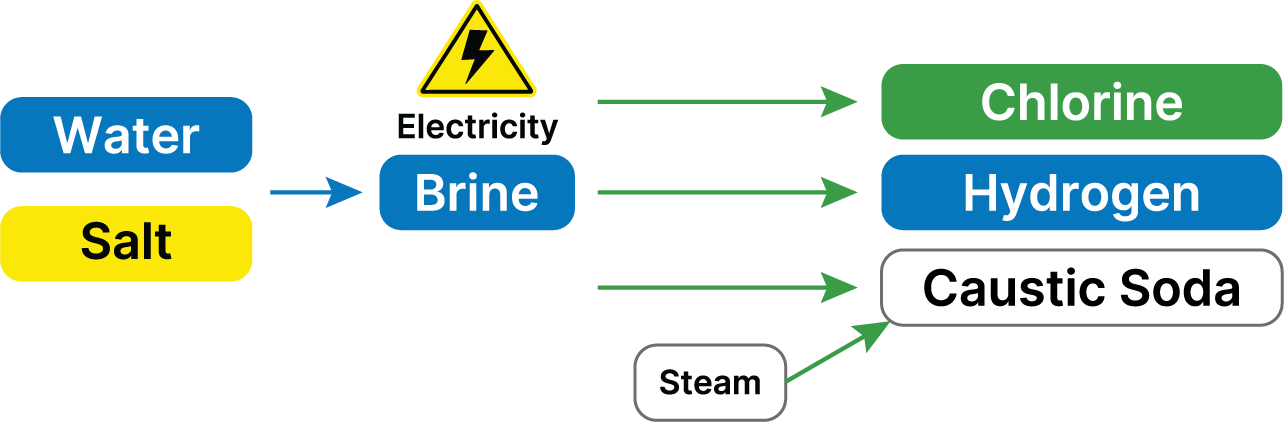
water to give brine, is the source we produce chlorine gas
(Cl2) from.
Where do we get our salt from?
About 50 quadrillion tonnes of dissolved sodium chloride (common
salt) are found in the world's oceans and seas. However, less than
a third of salt production stems from seawater. The majority comes
from rock saltmines hundreds of meters below the surface of the
Earth.
Read more about how we dig the salt up.
What do we use chlorine for?
Today, chlorine is used in a vast range of processes to create
thousands of often indispensable products that serve our everyday
needs at work, home and play. Examples include pharmaceuticals,
medical devices, windows, flooring and insulation material and
pipes, pure silicon for the production of photovoltaic cells. Water
and swimming pool disinfection are of course the best-known
applications, although they only account for a very modest
percentage of total chlorine production.
Read more about uses of chlorine.
Chlorine's co-product caustic soda is essential in many
industrial applications, among which the production of useful
organic chemicals (more than 30 % of caustic production goes into
this application), inorganic chemicals like paints, glass and
ceramic, fuel cell production, cosmetics, the paper, pulp and
cellulose industries, the food industry, soaps and detergents,
textiles, aluminum production and rubber recycling.
Read more about the uses of caustic
soda.
Is there a 'chlorine family'?
Yes: chlorine belongs to a group of five chemicals called '
halogens': fluorine, chlorine, bromine, iodine and astatine. The
word 'halogen' originates from Greek roots: hal means 'salt' and
gen means 'to produce'. All the chemicals in this group produce
sodium salts with similar properties. The best known is of course
sodium chloride (common salt).
Last update : 02/2012